Yesterday, Jeff Bezos lifted off in a Blue Origin capsule and nuked the Washington Post from orbit. It was, I suppose, the only way to be certain that the Washington Post would not even accidentally commit journalism and upset the regime.
Living in Harrisonburg, Virginia when my dad worked at James Madison, I grew up reading the Post daily. It’s why I think of myself as “culturally Washingtonian.” While I haven’t regularly read the Post in a number of years, it remained an institution, the paper of record for the nation’s capital.
Thinking about the Post, there are two little stories to tell about Diamond.
The first, and I can’t fix a date on this in my head, but it was sometime in the middle of the 2010s.
A colleague who shall remain nameless said to me one day that Diamond should unionize. I thought for a moment and said, “Either Writers Guild East or the Post Guild,” then named off a reason or two for each—WGA East was unionizing “new media” newsrooms, and the Post Guild was the union for the Washington Post and the Baltimore Sun.
Colleague replied, with some shock, “You’re serious. You’ve given this some thought. I just wanted to join the Wobblies.”
“They would work, too. They have good songs.” I paused. “Truth is, [Steve] Geppi would shut this whole place down if he ever had to deal with a union.”
I learned about two years ago that there was someone at Diamond who actually was serious about unionizing Diamond’s home office — three or four years without pay raises will do that to a company — but no one ever asked me.
That out of the way, let’s talk about the time Diamond considered getting in bed with the Washington Post.
In 2019, Diamond brought in a new management team to steer the ship, headed by Stan Heidman. And in early 2020, before COVID, some people on his team met with tech people at the Washington Post about licensing their CMS to replace Diamond’s homegrown CMS, NewsManager.
NewsManager, in a word, sucked. It had been written sometime before telegraph. It was antiquated and limited, brutalist in its design. For what it did, it was adequate as a back-end database of content, and there was one major upgrade — the editor was replaced with TinyMCE, a WYSIWIG editor — that enabled us to do things like embed YouTube videos. (With the older editor it had been possible, albeit kludgey, and editing the article would delete the YouTube embed.)
There had been talk for years about replacing NewsManager. I remember Dan Manser announcing circa 2011-2012 that he’d received authorization from Roger Fletcher, the VP for Marketing, and we would be moving to Joomla in the coming year. Surprise, the move to Joomla never happened, and it was never spoken of again. My guess is the numbers guys downstairs looked at the scope of the project and decided it wasn’t worth investing the time and money when we already had a system that was paid for and worked.
New leadership team and new ideas, though, and so there was a meeting about a new CMS.
I am not entirely sure who attended the meeting in Washington beyond Andy Mueller, the Consumer Website Manager, from the marketing side of Diamond, and everything I know about the meeting is through him. I think Joe Foss was there, and the new Chief Technology Officer, whose name I think was Savas, but don’t quote me on that. Point is, this is all secondhand. I do recall that the day Andy went to Washington for the meeting with the Post people, it was cold and rainy.
Andy, as I recall, was not super excited by this project before he went to Washington. His focus for a while had been on Pullbox, the consumer app that allowed comics readers to order comics and maintain pull lists with their comic shop through Diamond. (Considering the time and effort that was put into Pullbox—it spanned years—I still wonder if the ROI ever justified the project. I harbor doubts.) Yes, everyone admitted that Diamond’s websites needed updates, the retailer website especially, as it was the retailer website where Diamond made its money, but a new CMS wouldn’t necessarily modernize the websites to the end user. It would only change where the website got its input on the back-end.
Andy came back from Washington super excited about the Post‘s CMS. He talked about things like “the editorial calendar” (which could be visualized online), being able to assign articles to a writer, being able to track changes across multiple writers and versions. The Post team demonstrated all sorts of features that captivated the Diamond people, features NewsManager couldn’t do or that hadn’t been thought of. Apparently, the demonstration dazzled everyone, as Andy said they (the team that went to the presentation) discussed how Diamond’s data would have to be migrated to something that the Post‘s CMS could work with as they drove back.
I listened to Andy’s account, turning it over in my head. “That all sounds good,” I said, “but do we have enough writers to make this worthwhile? The amount of content you’re talking about, we don’t have the people for that.”
“No,” Andy admitted. “We would have to hire more.”
“And how much is this going to cost?”
The license for the CMS, Andy said, was a hundred and twenty thousand dollars a year.
$120k.
I didn’t say it, but I admit I had the thought that if you took the salaries of the writers in the marketing department and added them together the total would clear $120k but not by a whole lot. I was also cynical enough to know that while Diamond was willing to spend money when it wanted to, it wasn’t going to spend money to hire the writers to justify licensing the Post‘s CMS.
I don’t know if licensing the Post‘s CMS was ever seriously pursued after this meeting. This, of course, was January or February 2020, and, unfortunately, COVID stopped the project of replacing NewsManager dead in its tracks. I posted and reviewed some articles in NewsManager on my last day with Diamond, last September, and whoever remains has moved over to Enesco, as I understand it, and would be using whatever their system is. So, NewsManager has finally died, but out of neglect, not conscious choice to leave it behind.
In so many ways, those few months before COVID were an inflection point. I’ve often wondered, if Stan Heidman hasn’t run DC off, if he’d backed off on shaking them down and gotten a signed contract before the COVID shutdown, then DC wouldn’t have been able to bolt to other distributors. If that domino doesn’t fall, does Marvel leave the following year? (I was told they came very close to staying with Diamond when their contract was up for renewal that summer.) And then the chaos of the last few years and Diamond’s bankruptcy might have been averted.
Knock over one domino, and they all fall.
On a different, but still Diamond-related note, Facebook memories tells me that yesterday was the 9th-anniversary of Diamond’s 35th-anniversary party event in 2017.
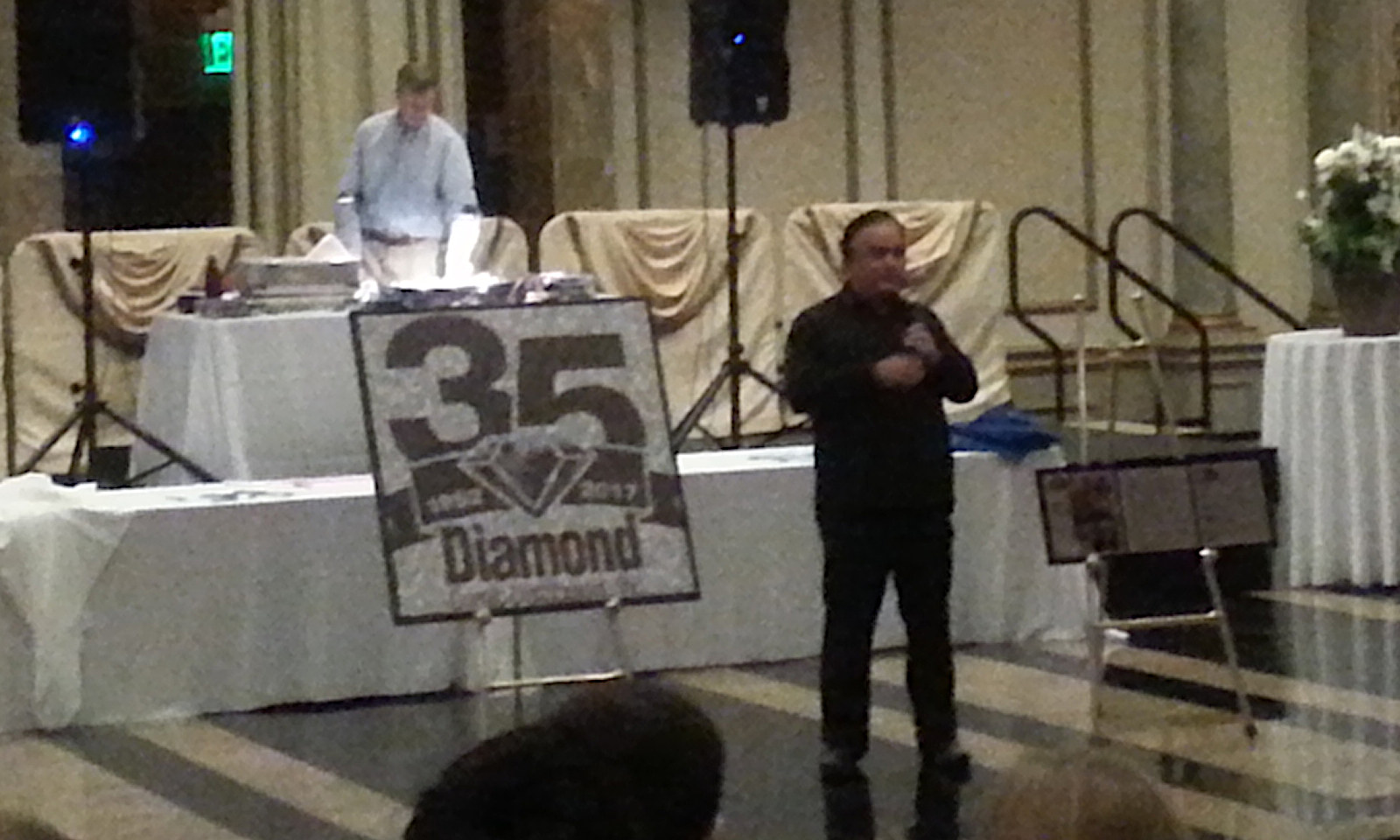
Quoting myself on Facebook from 2017: “The party favor at the Diamond 35th-anniversary party was a decorative pillow that celebrates the life and career of Cal Ripken, Jr.” These were bought from a salvage company, and as I said on the occasion of Bill Schanes’ retirement party, “Every expense was spared.”
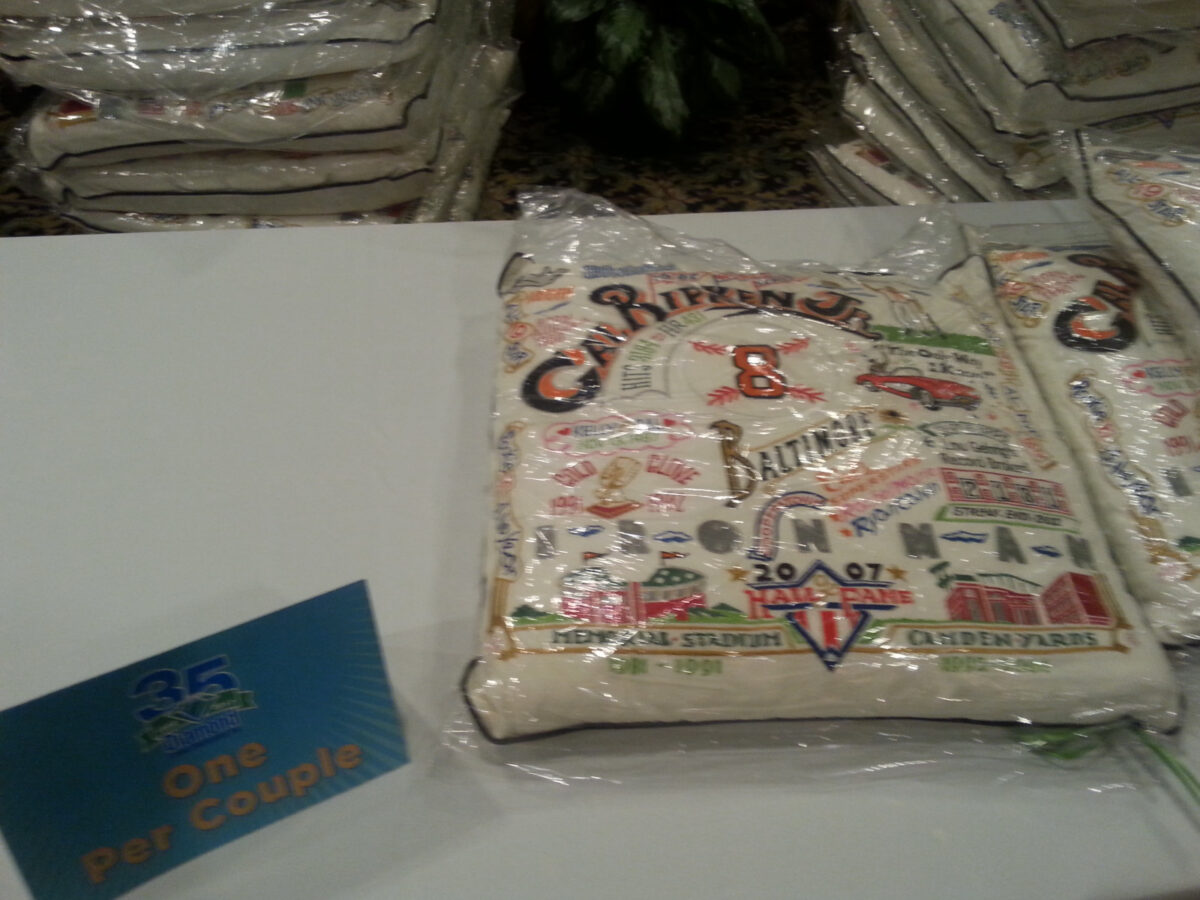
It’s a nice enough pillow, if you like that sort of thing. I ignored the sign and took two. I still have one; I gave the other to my mom and dad years ago, and they still had it in their living room before my mom’s death.
Professionally, 2017 was such a miserable year.